Smart Nutrition Kitchen : Model Pemberdayaan Keluarga Berbasis Pangan Lokal untuk Pencegahan Stunting
Abstract
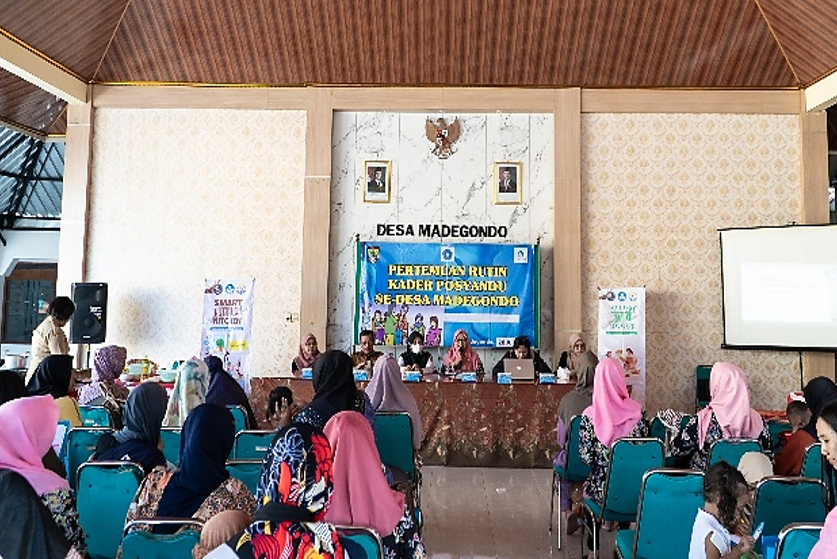
Stunting remains a major nutritional problem affecting the quality of human resources in Indonesia, including in Madegondo Village, Sukoharjo. Although local food resources such as catfish, tempeh, moringa, and cassava are abundant, they have not been optimally utilized for family nutrition. The Smart Nutrition Kitchen program was designed to empower communities through nutrition education, training in local food processing, the establishment of a community nutrition kitchen, and strengthening fathers’ roles in household food security. The implementation methods included counseling, training, hands-on practice, mentoring, and continuous evaluation involving posyandu cadres, mothers, and fathers of under-five children. The results showed a significant improvement in nutrition knowledge among cadres (from 48% to 97%) and mothers (from 31% to 82%) after the intervention. In practice, 70% of mothers successfully applied innovative local food recipes, while 30% adapted them to family preferences. Fathers’ participation also increased, with 70% of families starting home food security practices through hydroponics, polybag gardening, or catfish farming. This program has proven effective in improving knowledge, skills, and family involvement in utilizing local food, while also creating economic opportunities through local food-based products. Therefore, the Smart Nutrition Kitchen has the potential to serve as a sustainable model for stunting prevention based on household food self-reliance.
Copyright (c) 2025 Etik Sulistyorini, Salsabila Amalia Putri Bumi, Fitria Hayu Palupi, Joice Merry Christy Samuel, Reinata Candra Dewi (Author)

This work is licensed under a Creative Commons Attribution 4.0 International License.
Padma (Jurnal Pengabdian Kepada Masyarakat) accepts manuscripts that have not been published elsewhere and are not under consideration for publication by other print or electronic media. Authors retain copyright and grant the journal right of first publication with the work simultaneously licensed under a Creative Commons BY-NC License that allows others to share the work with an acknowledgment of the work's authorship and initial publication in this journal.
Authors are able to enter into separate, additional contractual arrangements for the non-exclusive distribution of the journal's published version of the work (eg, post it to an institutional repository, in a journal or publish it in a book), with an acknowledgment of its initial publication in this journal.
License to Publish
The non-commercial use of the article will be governed by the Attribution-NonCommercial 4.0 International (CC BY-NC 4.0). The author hereby grants Padma (Jurnal Pengabdian Kepada Masyarakat) an exclusive publishing and distribution license in the manuscript include tables, illustrations or other material submitted for publication as part of the manuscript (the “Article”) in print, electronic and all other media (whether now known or later developed), in any form, in all languages, throughout the world, for the full term of copyright, and the right to license others to do the same, effective when the article is accepted for publication. This license includes the right to enforce the rights granted hereunder against third parties.